ScholarLab Research Desk
  • Home
  • About the Research Desk
  • Archives
  • Meet Our Team
  • About ScholarLab
  • Contact Us

[ScholarLab Dispatch] "How to create the elearning your members need" at the Texas Society of Association Executives' Tech Talks Conference

5/19/2014

0 Comments

 
By Alexandra Caufin

Earlier this month Dr. Laurelle Jno Baptiste, ScholarLab's COO and Co-founder, travelled to Austin, Texas to present her innovative new workshop iLearn, iConnect, iGrow at Texas Society of Association Executives' Tech Talks Conference. Check out this summary that highlights the workshop's most important ideas about the future of learning online and why organizations around the world need to take notice!

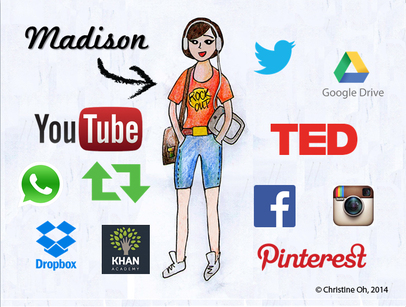
Meet Madison
PictureImage (C) Christine Oh, 2014
In the Age of Information, Madison is your quintessential digital native and more importantly, your new member. She is digitally literate, digitally socialized, and digitally cultured, looking to learn in the same ways she connects with the world every day. She has never known a world that couldn't be googled, and thus, access to information defines the tools she uses in daily life. Most importantly, she’s spurred by the wealth of knowledge, discourse, and communication that’s right at her fingertips, online.

As an association executive, you should get to know Madison, because someone just like her is coming to a classroom, workplace or association near you.  The question is, how are you going to capture her attention?

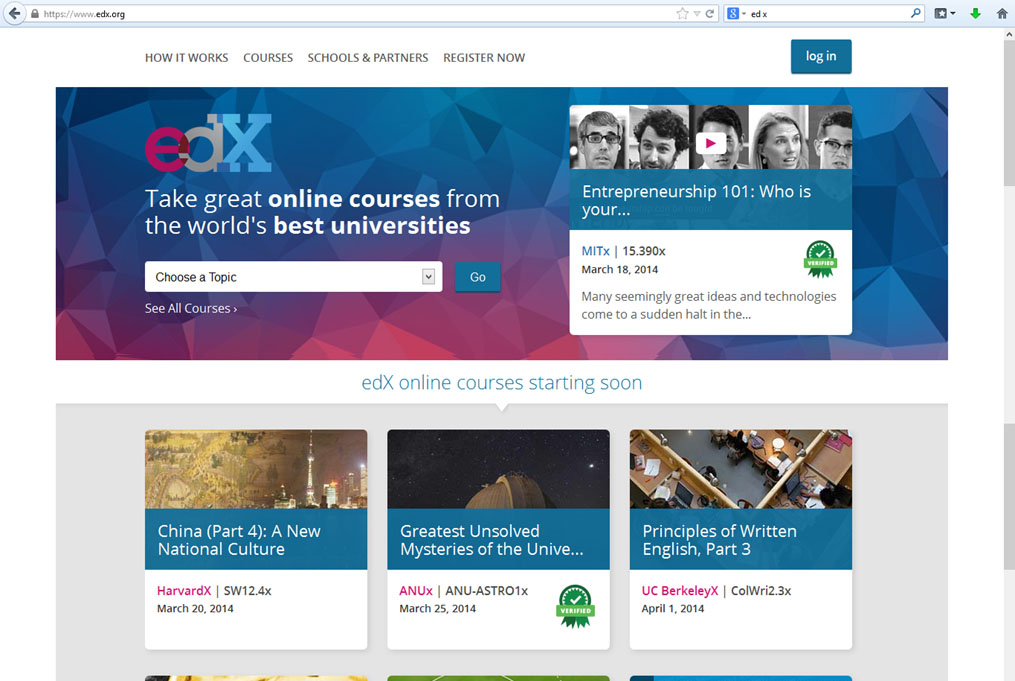
Web 2.0: A new era of online learning technologies
Picture
Web 2.0
Picture
Web 1.0: Many associations are still using systems rooted in web 1.0 technologies
In 2014, we’re securely in the Web 2.0 age of the internet. It’s the age of mobile devices, tablets, apps, video conferencing and instant messaging technologies. With these technologies, the world has seen an upheaval of outdated and inefficient online learning systems and watched a new era of global education, digital literacy and cross-the-world communication emerge. For the first time in history, we have the technology and the tools to create a virtual experience that is on par or even superior to the in-person equivalent.
75% of American colleges and universities now offer online education programs.
Over 6 million learners in the post secondary system are taking courses online.
67% of educators believe that online education is on-par with or superior to learning in the classroom.


Barriers: Do you have learning communities for people like Madison?

Learning communities mean much more than just a classroom or some online courses. They represent an ecosystem of tools for members to not only learn, but to discuss, share, create and network along the way.

Issue 1: Madison wants to take your course but can’t make the 45 minute commute to your association’s headquarters. Plus between her school, practicum and other volunteer responsibilities, she can’t guarantee her availability every week at the same time.

Issue 2: Madison has taken one of your courses online but found the course layout, design, and content delivery outdated, text-heavy and administrative.

Issue 3: Madison is interested in your online learning programs, but none of your courses or events can be viewed on her iPhone or iPad, nor do they involve any kind of networking or social media functions. She instead opts for an online course or event that is mobile-friendly and collaboration-oriented.

What started out as a great opportunity for Madison to connect with your association has become complicated and stressful, so she seeks another vendor.

Breaking down barriers:
What are your new and existing members looking for?


Are you developing your education strategy with learners like Madison in mind? Here are some of the elements that new learners look for, and elements that you can provide by making the jump to learning in the digital:

Just-in-time learning: Turn your one-way, one-time only courses, presentations or events into ongoing resources, with unlimited outreach to potential members worldwide.

Mobile-friendly technology: With the mobile classroom, learners can use their smart phones and tablets to view your courses, conferences, presentations and events anywhere they want, whenever works for them.

24/7 access: Give members around-the-clock access to course presentations and materials, and the flexibility to learn in the way that works best for them.

Pause, skip ahead, replay: Let your members learn at their own pace, take notes, review or move ahead. You’ll be creating learning environments that cater to individual learners instead of the masses and your members will appreciate it.
 
Economic renaissance:
The rapid development of technology has made it far more economical to bring content online. Associations all over the world are using new forms of webinars, learning systems, video conferencing and more to attract and connect with learners all over the world.


Why use video?

68% of teachers
believe that video content helps stimulate discussions.


44% of high school students
in a study scored higher on their exams when material was presented in video format.


62% of teachers
believe that video helps them be more effective.


When you
hear information,
3 days later you will recall
10%.


When you
see images with audio, 3 days later you recall 65%.


Uncover the potential! 
Picture
Digital learning communities open doors and create borderless connections. Your biggest question as an association should be: how do I attract the enormous demographic of new members?

Remember that these new members are intricately attracted to new learning communities.

We now have the technologies to address the biggest issue that associations face: how to connect with all the people who would like to come to take courses or attend your events, but can’t.


Adapted from Dr. Laurelle Jno Baptiste’s Tech Talks workshop “iLearn, iConnect, iGrow: How to create the online learning your members need.”

Source List
Infographic clip: 75% of American post-secondaries offering online education etc. http://blog.hotspotshield.com/2014/01/16/rise-online-education-infographic/
Online Learning Stats: http://www.edudemic.com/thumbs-online-learning/ 
via, created by http://www.coloradotech.edu/
“Why use video?” statistics from http://brainrules.net/pdf/BrainRules_JohnMedina_MediaKit.pdf and http://www.edudemic.com/use-video-education/


0 Comments

The 5 Ws Of Tweeting About Your Elearning Programs

4/27/2014

0 Comments

 
By Christine Oh
5 Ws of Tweeting about online learning/elearning
takayuki/Shutterstock.com
WHY: You don’t need us to tell you how important having a strong Twitter presence is. It’s how your members read the news, connect with friends (and strangers!), and keep up-to-date on their industry. Tweeting is a no-cost way of getting the word out about your elearning programs to your members. It can build up excitement for an upcoming course by getting the conversation started, and it can spark new interest in existing courses by reminding members about them. The sharability of tweets also helps you reach potential learners who don't know about your courses. So the truth is, not using Twitter as part of your outreach approach just isn’t an option anymore.

WHEN:
To ensure that your tweets are consistent and well-timed, it’s important that you establish a daily schedule. Try planning out your tweets in three-week phases, especially if you've recently launched a course. Here is a suggested schedule:
  • Week 1 of the campaign: Three tweets per day: one between 10am-11am, one between 3pm-4pm, and one between 6pm-7pm
  • Week 2 of the campaign: Two tweets per day: one between 10am-11am and one between 3pm-4pm
  • Week 3 of the campaign: One tweet per day: one between 3pm-4pm
If you're doing a three-week campaign leading up to the launch of a course, you'll want to reverse that order: in the first week, tweet once a day. Then in the second week tweet twice a day. And finally, in the week leading up to the launch, tweet three times a day!

WHERE:  Where will you tweet from? Scheduling software like Hootsuite allows you to schedule your tweets ahead of time in one sitting, so you don’t have to worry about being out of the office or forgetting when and what to tweet weeks down the road. Hootsuite’s basic scheduling functions are free, so we encourage you to give it a try. If you would still prefer to tweet manually, make sure to create calendar reminders for yourself and your team to stay on schedule.

WHO: Make sure you identify who will be responsible for each of the following steps in the process:
  • Creating a tweeting schedule
  • Researching what’s hot in the twittersphere, which keywords to use, and related articles and blog posts that complement your courses
  • Writing out tweets and checking that they fit in the character limit
  • Scheduling tweets or tweeting on the spot according to the tweet schedule
People involved could be anyone in social media, marketing, communications, education, and of course, yourself. Consider your resources and figure out who would be best for the job.

WHAT: 
Explain...
  • Why taking this course is important and what new skills can be gained through the course
  • Why taking this course in the online environment is beneficial
  • If you have more than one course or session in your catalog, mention what each session topic is and why it’s relevant (tweet at least 1-3 times for each course or session)
Use...
  • Compelling statistics to catch people's attention
  • Photo or video attachments
  • A conversational tone that is approachable and friendly
Hashtags:
  • Key terms relevant to your industry (e.g. #RealEstateEd #CME #Legal)
  • Event names if your content was recorded at a conference (e.g. #ChicagoAGM #Conference2014)
  • Trending topics that you can tie into your programs (e.g. If there is a spring deadline for registrations and the hashtag #Spring2014 is trending, make sure to use it!)
Links:
  • A five minute preview! Hook readers in with a quick way to find out more about the course
  • Your online learning system homepage
  • Articles about the benefits of online learning
0 Comments

Don't get lost in the sea of options: Turn wandering website visitors into valuable online learners

4/25/2014

2 Comments

 
By Christine Oh
Picture
Your organization’s website is arguably the most important marketing tool to attract new online learners and generate sales. Your organization has full control of the website content and you don’t have to pay advertising fees like you would externally. Best of all, you already have potential learners right where you want them—at a computer and receptive to information about your organization’s programs. Don’t let them slip through the cracks! There are simple things you can do to seamlessly convert wandering website visitors into valuable online learners.

Take a minute to read through this checklist of things you can do to optimize your website’s marketing power.

Checklist: Are you doing a good job of marketing your online learning programs through your website?

Takes one click to move from the following pages of your website to the learning portal
  • Homepage -> Learning portal
  • Education page -> Learning portal
  • Events page -> Learning portal

Visuals of the learning portal (e.g. screenshots of the course) are clearly noticeable when people first enter your website
  • Website visitors should not have to scroll or click anything to see the visuals
  • If you have a rotating slideshow on your homepage, make the learning platform the first slide

Sidebar advertisements

  • Automatically scroll down along with the page
  • One-click link to the learning portal

In the Education section of your website (If you don’t have one, create one!)
  • Education should be one of the main menu options of your website
  • List of courses available online with descriptions
  • If applicable, state the number of continuing education credits (CLE, CME, CPE, PD, etc.) that can be completed online
  • One-click link to the learning portal

At the end of all event-related news and/or coverage (if you have recorded speakers from an in-person event)
  • State that online versions of the sessions are available
  • One-click link to the learning portal

If you have a News or Blog section on your website
  • Multiple articles and/or posts about your online learning programs from different angles
  • Spotlight and/or interview prominent figures (e.g. Executive Director, Education Director, and/or course instructors)
  • Why the course topic(s) are important and why your organization felt it was important to take online
2 Comments

Top 5 reasons why your conference needs to go digital

4/15/2014

2 Comments

 
Digital/online conferences/events/meetingsMaxim Blinkov/Shutterstock.com
By Alexandra Caufin

As the leader of an association, you know how important your annual conferences and meetings are for your members and for the financial strength of your organization. Conferences across the world are going digital with an exciting array of  new live streaming and video-conferencing technologies, and yours should be no exception.

Going digital with your conference is no longer a cutting-edge idea only for the technologically brave. It’s now both easy and inexpensive—and more than this, it’s going to be necessary for the survival of your association. Here’s why:


Picture
Expand your reach.
By going digital, your conference suddenly becomes accessible to members and potential attendees all over the country, and even, the world. By creating an online knowledge environment, physical location is no longer a  factor or barrier for people interested in attending your conference.

Picture
Connect with the net generation.
The upcoming generation of learners are tech savvy and eager to learn in the same way they’ve been socialized. This means digitally. Being able to provide your net generation members with digital opportunities to participate in conferences will set your organization apart from those that are still stuck in traditional and limited conferencing delivery.


Picture
Maximize value proposition for attendees.
The simple fact is, you can’t be in two places at once. This is especially problematic when your conference attendee wants to attend multiple sessions at the same time. If conference-goers had the opportunity to participate in every session of a conference, some physically and some that have been digitally recorded, it would present an obviously greater value proposition than one-time only conference sessions.


Picture
Attract potential new members with more economic online pricing.
Non-member tickets for conferences can be very pricey, and yet, conferences are an amazing way to attract potential members to your organization. By digitizing your conferences, you can offer special online passes for the conference at a reduced rate. It will appeal to your non-members who are considering joining the organization, want to see what it’s all about, but don’t want to pay a massive non-member fee to attend.

Picture
Build new revenue streams.
Going digital means that you can offer potential attendees more options for attending the conference, and a wider price range in tickets. Participants can buy a pass for a certain amount of online sessions, a full online pass or an inclusive conference pass that allows them access to all physical and online sessions. The options are endless and you’ll be appealing to all kinds of learners, some of whom want an in-depth conference experience and some who want less of a time and financial commitment. You’ll also be able to repurpose recorded sessions for online courses. Add quizzes, surveys and certificates and create accredited courses for your members online!

2 Comments

Mental Health Goes Digital

2/19/2014

0 Comments

 
Intro by Alexandra Caufin
People of all ages and social demographics are calling for action against a rising epidemic of mental illness across North America. This year, one in four Americans 18 and older will struggle with a diagnosable mental illness and many will not seek medical care (almost half of all Canadians who suffer from depression or anxiety have never seen a doctor about it). Without awareness, intervention and access to care, the cycle persists: mental illness is the number one reason for disability in North America and suicide remains the fourth leading cause of death in adults, more common than death by diabetes or stroke. 
 "Our online learning environment affords a safe and comfortable space for employees, conducive to the sensitive discussions that orbit mental health awareness."
- Canadian Mental Health Association 
The Canadian Mental Health Association (CMHA) is stepping up as a first responder, announcing the launch of a three-part digital course Managing Mental Health in the Workplace. These kind of programs have been heralded as game changers––the difference between someone identifying mental illness and recovering, rather than allowing the disorder to spiral out of control affecting everything from family life to social life to professional life. 

CMHA’s recent release discusses the exciting new online project and zeroes in on thought-provoking articles, infographics and a TED Talk on how technology can and should be leveraged to combat mental illness. We couldn’t help but share!

Released by Canadian Mental Health Association earlier this month:
Canadian Mental Health Association Workplace
Here at the Canadian Mental Health Association (CMHA), we are passionate about using technology to improve mental health awareness by providing better access to mental health training. With the fantastic results we’ve seen from initiatives like Bell Let’s Talk, the CMHA is proud to be taking our Managing Mental Health in the Workplace course digital. 

In partnership with ScholarLab, a leading innovator of online education in North America, we’ve developed an interactive online course loaded with helpful, perspective-shifting modules on mental health. Plus, our platform is accessible anywhere and adaptable for your individual employees.

How does it work?
Our professionally-filmed video lectures really give the feel of an in-person instructor-led course. But with pre-recorded content, you can pause and conduct discussions or backtrack to review major points and learning outcomes. Employees can register individually (or in groups for special rates) and begin the course right away. The system automatically tracks progress and organizes the modules so you and your employees always know where to pick things up again.

What are the benefits?
  • By taking this course digital, CMHA is reaching out to employers on a national level.
  • Studies show that implementing just-in-time learning results in time and cost savings, enhanced engagement and constructive changes in behaviour. Your employees won’t have to take time off or wait for an in person, one-time-only session. Consider this: a difficult mental health situation has arisen in the workplace. With the format of our online modules, your human resources team can log in and access critical information exactly when they need it.
  • Our online learning environment affords a safe and comfortable space for employees, conducive to the sensitive discussions that orbit mental health awareness. Employees will have privacy and flexibility in exploring their own perception of mental health which they may not be comfortable doing in a conventional classroom.

Is this the right choice for my organization?

Well, the Research Institute of America reported that online learning can advance knowledge retention by 25%-60%, especially because your employees will have the opportunity to revisit the training as needed. Plus, in terms of efficiency, a study conducted by Brandon Hall Research found that when compared to conventional in-classroom learning, online education requires 40%-60% less employee time.

If you’re curious about the benefits of online learning and want to learn more, don’t hesitate to get in touch. We’ve assembled a selection of helpful articles, studies and infographics, below.

Resources
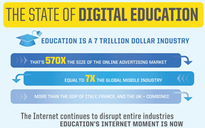
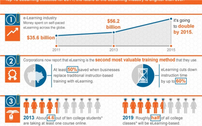
State of Digital Education
The State of Digital Education

Statistics Elearning Manager Should Know
Top 10 eLearning Statistics Every HR Manager Should Know

How the Internet is Revolutionizing Education

Why Improving Workplace Mental Health is Good Business
Why Improving Workplace Mental Health is Good Business from The Globe and Mail

Online Innovations 2014 Edutech

Edutech Gallops into the Year of the Horse: Five Online innovations We'll see in 2014 from the ScholarLab Research Desk

TED Talk EdX Online Education
Reshaping the learning experience with online education. TED Talk by Anant Agarwal, President of edX. EdX is a non-profit online initiative founded by Harvard and MIT.


Source List

National Institute of Mental Health - Leading Cause of Death (2007)
National Institute of Mental Health - Health and Education
Canadian Mental Health Association - Fast Facts
0 Comments

Fine-Tune Your Online Education Pricing and Hit The High Notes In Sales

2/18/2014

1 Comment

 
By Christine Oh
Online Education Elearning Pricing Marketing
Too often organizations treat the pricing of their online education programs as an afterthought. And yet, experts say that it is one of the driving factors that impacts sales, and should be determined as early as possible. If your organization is in the planning, launch or even post-launch stage of an online education program, here are some actions that will help you fine-tune your pricing to reach your ideal learners:
 
DO YOUR RESEARCH: 
Determining pricing should not be an independent exercise. Collect research on other factors like the cost of comparable in-person courses, the value of the content (i.e. do participants receive credit or certification for the course), the average prices in the industry for similar content, and the prices of your competitors. You might also have to experiment with discount codes and other promotions to find a sweet spot.
TOO HIGH? TOO LOW? Common sense tells us that high prices deter learners from purchasing your courses because they cannot or will not pay. But don't fall into the trap of thinking that lower prices will automatically mean more sales. If your learners perceive your prices to be too low, they may assume your content is low quality, outdated or irrelevant. Not only that, you lose the opportunity to have higher profit margins on your content.
"Don't fall into the trap of thinking that lower prices will automatically mean more sales."
WALK IN YOUR LEARNER'S SHOES: Consider how a learner’s willingness to pay will be impacted by factors like level of education, income, geographical location and age. For example, disposable income generally rises with age, and therefore your prices should be lower to attract a younger generation and higher for a more mature group of learners. Which demographic you want to attract will depend on the type of content and your organization’s unique goals and objectives.
1 Comment

[ScholarLab Dispatch] Visions of Change at NABE's Midyear Meeting 2014

2/13/2014

0 Comments

 
By Christine Oh
Picture
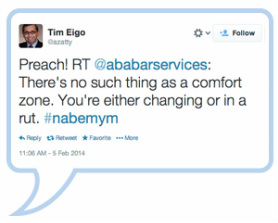
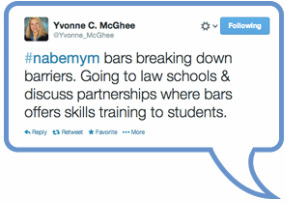
ScholarLab hit the road to attend the 2014 National Association of Bar Executives (NABE) Midyear Meeting in Chicago earlier this month, where the presentations, conversations and even tweets circled around the theme of embracing change. It’s true, we’ve reached a new era of law (click to read why), and it is becoming more and more evident that bar associations need to be evolving to the changing demands of today’s lawyers. 

Picture
On the online learning front, this only reinforces how important it is to take a hard look at how lawyers learn today and in turn, build programs that cater to their education needs. Some bars have taken the leap into online CLE, but they’re seeing poor sales and still fighting criticism that bar associations should be doing more for new lawyers. 

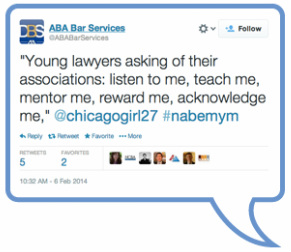
The programs are, according to the conference’s twitter feed, failing to facilitate the interactive learning, network and post-graduate skills that lawyers need to successfully enter the legal marketplace.

Picture
But how to put such programs into motion? In a time with such sophisticated learning technologies at their fingertips, bar associations need to modernize their programs to walk in stride with the capabilities of our time. This means moving past the outdated systems that rely simply on the live streaming of content. Instead, bar associations can be providing members with an ecosystem of education and communication tools that will facilitate a more complete, networked and engaged learning experience. 

Picture
At ScholarLab, we are always asking ourselves, what keeps learners coming back? The answer at the end of the day is always a superior learning experience. It’s time we start giving lawyers just that. 

If you’re interested in learning more about some of the great ideas laid out at the conference, look out for online versions of select sessions from the meeting coming soon at: http://nabe.scholarlab.com/

0 Comments

Purveyors of Knowledge: How Bar Associations will become key players in the new era of legal education

1/26/2014

2 Comments

 
By Alexandra Caufin
The verdict is in: Crisis has settled upon the legal sector. In 2012, only about 50% of new law graduates were practicing law within nine months of graduation. 27.7% were actually un- or underemployed, pursuing other degrees or leaving the industry altogether. At the same time, longstanding law practices continue the struggle to survive, slashing the jobs of even seasoned legal professionals. 

The culprits? Well for one, more and more new law graduates are appearing annually and they’re unfamiliar with the opportunities available to them beyond junior roles at law firms (who, by the way, aren't hiring). A growing client-base needing legal services for less means that clerks and paralegals are taking the roles that new lawyers once held. Alternatives that have popped up—virtual firms, automated risk management services, and online legal and dispute resolution—offer niche services at a fraction of the cost of law firms. We know this much: the game is changing and everyone will have to adapt. But in the eye of the storm, even legal experts say it’s difficult to know what the future of law practice will actually look like. 
Lawyer Legal CLE Education
Burlington Studios, 1912

Bridging the Gap: Building CLE for new lawyers and legal professionals

And yet, amidst this time of crisis, bar associations have a strange new opportunity to step up and incite change. This means reorganizing to become central hubs for Continuing Legal Education (CLE), creators of modern knowledge communities, and indispensable resources for legal professionals and law firms alike. Associations like the National Association of Bar Executives, Iowa State Bar and the Pennsylvania Bar Institute have already begun to build virtually-minded programs that reach out to new graduates and longtime practicing lawyers, get a dialogue going and a pulse on the most pressing subjects now needed in Continuing Legal Education.
In the intricate conversation about why new graduates and first and second year lawyers can’t find paid positions, Ida Abbott, award-winning consulting lawyer and author puts it plainly: They’re inexperienced. At least that’s how they’re being perceived by clients and firms alike. The industry, she says, is losing so many brilliant minds because they need professional experience but are unaware of different legal careers paths. In creating rich, interactive, and accessible-from-anywhere learning environments, institutions who can bridge the gap have the potential to become as relevant as law schools themselves. And that’s where Web 2.0 comes in. 

Law Goes Digital: Modernizing CLE in content and delivery 

Why modernize? Like virtually every other industry, legal has seen an eruption of new commercial sectors. Online risk analysts who work virtually to provide legal advice; E-discovery specialists and litigation support that are research-oriented; virtual firms and web-based services that allow legal advisors to login from all over the world, enabling longer-hour access, rapid contact and communication, and often, reduced costs for the end client. With these online-based enterprises, an entirely new skillset is emerging in the legal sphere. How do we get our seasoned legal professionals up to speed? 
Many bars are already looking to the on-the-go production of content now possible via mobile capture and platforms that go past simple live streaming from a physical facility. The technologies offer a way for lawyers and legal educators alike to engage in frictionless teaching and learning that can happen from their office desk or their iPhone or their kitchen table or even, from the courtroom. Bars can use sophisticated CLE programs to educate in job transitioning and help fashion a greater fluency with new technologies in the sector, ensuring that as the field modernizes, lawyers can modernize their own skills with it.  

Building the Network: Linking learning with e-mentorship

Exhibit A: Law Without Walls. It’s a new initiative by the University of Miami law school. It brings together firms, legal corporations and law schools worldwide, setting students up with mentors and advisors. Among a mob of new challenges, creating virtual opportunities for new graduates to connect with one another and with more experienced lawyers, presents a major opportunity for bar associations to step up and be the matchmaker. 
As the pre-existing middleman in the law community, bar associations can leverage the wealth of online technologies at their fingertips to construct a sustainable network: create cross-state, cross-province and cross-nation dialogue, facilitate information exchange, create online programs on competitive techniques for job seekers in the field. Help foster exposure to seasoned lawyers via online courses, webcasts, workshops and seminars. Establish e-mentorship programs and pair new legals with the role models that can help them develop the distinct professionalism that isn't taught in school.

With these changes, bar associations have the opportunity to center themselves in what will be a new era of practicing law. Lawyers across North America are calling for change and if bars can be the ones to respond, they’ll become more than administrators, they’ll become a part of the education process at large. 


Cited:

The Real Employment Numbers for the Law Class of 2012
Connecting Core Competencies: New Graduates and the Bar (Lecturer Ida Abbott)

2 Comments

The doctor is Now In, and she will skype with you: 4 Reasons Why Online Continuing Medical Education (CME) is a Prescription for Success

1/26/2014

0 Comments

 
By Alexandra Caufin
PictureShutterstock.com
Dr. Jayne Lee is not quite a teleporter but she’s about as close as it gets. A major proponent of telemedicine, Lee is a Paris-dwelling physician who treats her patients in North Carolina and Kentucky straight from France using robotic technology. And she’s not alone. In December 2013, the tv-famous psychiatrist Dr. Phil McGraw made headlines by announcing his role as advisor to Doctor on Demand, a new enterprise designed to provide care via mobile medicine.

In a world where society’s inevitable adoption of technology has made it possible to completely reinvent how we communicate, socialize and learn, healthcare is no exception. McGraw and Lee may seem like cutting edge futurists, but they are just two unique stories of the many healthcare professionals turning to technology to improve quality of care. 45% of clinicians now use smartphones and tablets to collect data at their patients’ bedsides. In fact, nearly all healthcare IT professionals report that their organizations supply mobile devices to clinicians to support day-to-day work activities, and 2 out of 3 have an official mobile technology plan in place.

We’re not just seeing technology being used in patient care, medical education is going digital as well. In 2012, for example, 40% of practicing physicians in North America were using online Continuing Medical Education (CME) to satisfy their annual requirements, up dramatically from 18% in 2005. By evolving the way that we deliver medical education, we are seeing real potential to in turn evolve the way we heal, treat and give care. Here are the four reasons why technology will continue to transform medical education and thus, the face of healthcare this year.


Picture
MOBILE CHARGED MEDICINE
Some studies indicate that as much as 80% of physicians have implemented mobile technology approaches in providing patient care, improving ease in communication, data-taking and the sharing of information. With mobile devices already in their hands, healthcare professionals will have greater access to a ripening ecosystem of digital medical education, unify their working life with their continued pursuit of knowledge.


Picture
CME FOR A MODERN WORLD
With increasingly longer wait times across North America, physicians are overbooked and scrambling to manage busy practices, and thus attending onsite CME is becoming less and less feasible. Many are turning to the anytime, anywhere, self-paced convenience that online CME offers to on-the-go professionals. As technology continues to develop with applications like interactive webinars, livestream lectures and learner-centred platforms, online CME becomes the central environment for collaboration and knowledge sharing.

Picture
THE ECONOMIC EDGE
If we're talking dollars and cents, the ability to participate in CME remotely has resulted in sizeable cost savings, both for learners and course developers, sometimes as much as 50%, when compared with in-class equivalents. With budget cuts and the downsizing that healthcare organizations are facing, saving money on education programs is a welcomed benefit. Ten years ago, course creation tools were labour intensive, and producing just one hour of online content could have easily cost $10,000. Better creation technology has made it far easier, faster and more inexpensive to develop online courses for medical professionals.


Picture
ENHANCED ACHIEVEMENT, ENHANCED CARE
The million-dollar question: are online CMEs as effective as their traditional in-class counterparts? Available research suggests yes, especially in terms of enhancing the learning experience in the medical sector. Put it this way: we now have a robot that can virtually enable a doctor to do her rounds from across the world. We have the technologies, and it does seem as though the ability to create online education that is as engaging, as involved, and as impactful as in-classroom learning, is very real. In some cases, achievement levels stand to be superseded because of a greater access, a superior method of information exchange, and more tools to facilitate collaboration with peers. 


Cited:

2nd Annual HIMSS Mobile Technology Survey, December 3, 2012
ACCME 2012 Annual Report

0 Comments

Edutech Gallops into The year of the horse: 5 Online innovations We'll see in 2014

1/26/2014

2 Comments

 
By Alexandra Caufin
Picturebloomua/Shutterstock.com
It was a good year; 2013 saw the release of the first-ever Google laptop, the rise of globally accessible education via the Massive Open Online Course (MOOC), the eager implementation of the flipped classroom model and growth of platforms like Khan Academy, and a new feverish development around cloud computing. The second era of online education—one with multimedia, interactivity and social media rich at its core—has, aptly, reached a galloping pace as it proceeds into 2014, the Year of the Horse.

It’s no coincidence. The technologies coming out of the woodwork are answering a public demand to make education more accessible globally, more affordable, more practical for working adults, and more relevant in our digital and mobile-centric world. We’ve reached unbelievable momentum in the evolution of online learning tools, and here’s what we’re betting you’ll see more of in 2014:


Picture
VIDEO BECOMES THE MEDIUM
Heavy-hitting platforms like Skype, YouTube and Vimeo paved the way for the now massively popular TED talks, releases like 2013’s Vine, and a slough of other video-based mobile apps. Effectively every major social platform now boasts a video chat feature from Facebook to Gmail to your iPhone’s FaceTime. With video, we at last have the opportunity to change how we deliver knowledge, granting a perpetually widening access to learning content. As our methods for recording, live streaming and sharing continue to sophisticate with better hardware and software, video in everyday life will become as commonplace as the in-class lecture, boardroom presentation, conference or seminar.

Picture
COLLABORATION 3.0
The buzzword of 2013, collaboration will only surge forward this year, fuelled by technologies that have been designed to facilitate peer-friendly group work. Advances in cloud computing—Dropbox, Google Docs, Wikis and blogs to name a few—offer the tools needed to collaborate on projects, whether that it be in the same office, in different states or provinces, or even, across the world. With these capabilities at their fingertips, new graduates will be able to work and learn in the way that they socialize, continuing to blur the lines between learning, networking  and socializing.


Picture
A ROGUE CERTIFICATE SYSTEM will rise from the influx of continuing education learners and the public’s ongoing criticism of the conventional university degree. We are beginning to see online programs that compete with university and college certification in the way of theory, practical skillsets and sophisticated evaluation systems (read: grades). Khan Academy for instance, awards ‘badges’ with the successful completion of its courses. Alternative learning certificates, diplomas and the acknowledged participation in online workshops and seminars will become the norm on resumes and CVs, complexifying the concept of a single person’s “education.” Associations and organizations, in turn, will be able to deliver more highly-recognized certification to their members.


Picture
LEARNER CENTRIC EDUCATION
Long ago we discovered that the learning process is as unique for every individual as their own fingerprint. And yet our education systems are still touting the one-way, one-time-only, one-size-fits-all lecture. Online initiatives are responding by providing unique, adaptive programs and technologies for a spiralling spectrum of students. With the advances in user-based customization on the Web (think LinkedIn suggesting job openings that fit within your skillset and suggesting articles that coincide with your social demographic), the future of education technology will offer platforms that empower the learner by pinpointing distinct strengths, weaknesses and interests.

Picture
DIGITALLY SUSTAINABLE INSTITUTIONS
will be the only institutions to survive in our brave new digital world. With an eager upcoming generation of digital natives who interact with mass media via a myriad of devices, those who fail to adapt will fail to capture their interest. Does your association have engaging online content accessible on computers, iPads and mobile devices? Do you use social media to share new learning opportunities with members? Do you offer any kind of digital environment that connects multimedia-rich learning with social collaboration? 2014 will make way for institutions who are ready and willing to join the digital revolution. Competition will up the stakes, entice innovators to push boundaries, and advance the face of learning online.


2 Comments
Forward>>

    Categories

    All
    2014
    Collaboration
    EBook
    Healthcare
    Legal
    Marketing Tips
    Meetings And Conferences
    Mental Health
    Mobile
    NABE
    Online Education
    ScholarLab Dispatch
    Twitter
    Video

    Archives

    April 2015
    February 2015
    January 2015
    October 2014
    August 2014
    July 2014
    June 2014
    May 2014
    April 2014
    February 2014
    January 2014

Powered by Create your own unique website with customizable templates.